Activity

© Bertrand Waridel
Tour du Gros-de-Vaud / Stage 2 from Echallens to Penthalaz
The Tour du Gros-de-Vaud is a five-stage walking route, ideal for exploring the region. Around 70 kilometres long, this walking route is divided into five stages. It forms a loop around Echallens, passing through countryside, forests and rural villages. Following a variety of paths, it offers a comprehensive overview of the Gros-de-Vaud district and its heritage.
Stage 2: from Echallens to Penthalaz
Distance: 14.3 km
Duration: approx. 3
hours 40 minutes Total ascent: 160 m
Total descent: 350 m
Highest point of the stage: 620 m
Lowest point of the stage: 425 m
Echallens We leave the district’s main town, walking past its medieval castle. Built in the 13th century by Amédée III de Montfaucon, it now belongs to the municipality of Echallens. These days, the castle doesn’t look all that imposing. In the past, it was surrounded by a moat and accessed via a drawbridge. On leaving the village, we reach the River Talent, which we follow along narrow forest paths. It is common to come across foxes lying in wait or herons fishing in the river.
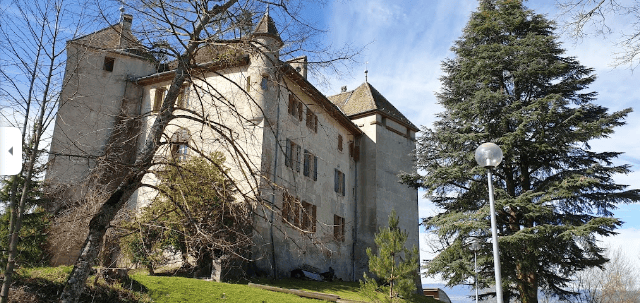
St-Barthélémy The Château d’Echallens gives way to the Château de St-Barthélémy. Built on top of a hill by one of the oldest noble families of the Gros-de-Vaud region, the de Gumuens family, this castle is mentioned as early as 1160 in certain documents. Despite its venerable age, it is very well preserved. Today it houses a social and care centre for people with disabilities. Situated below, the castle farm is also part of this complex, and a short footpath links the two buildings. A petting zoo showcases farm animals as well as numerous birds. A small shop offers a chance to sample local produce and homemade pastries. This is a very pleasant place to stop off.
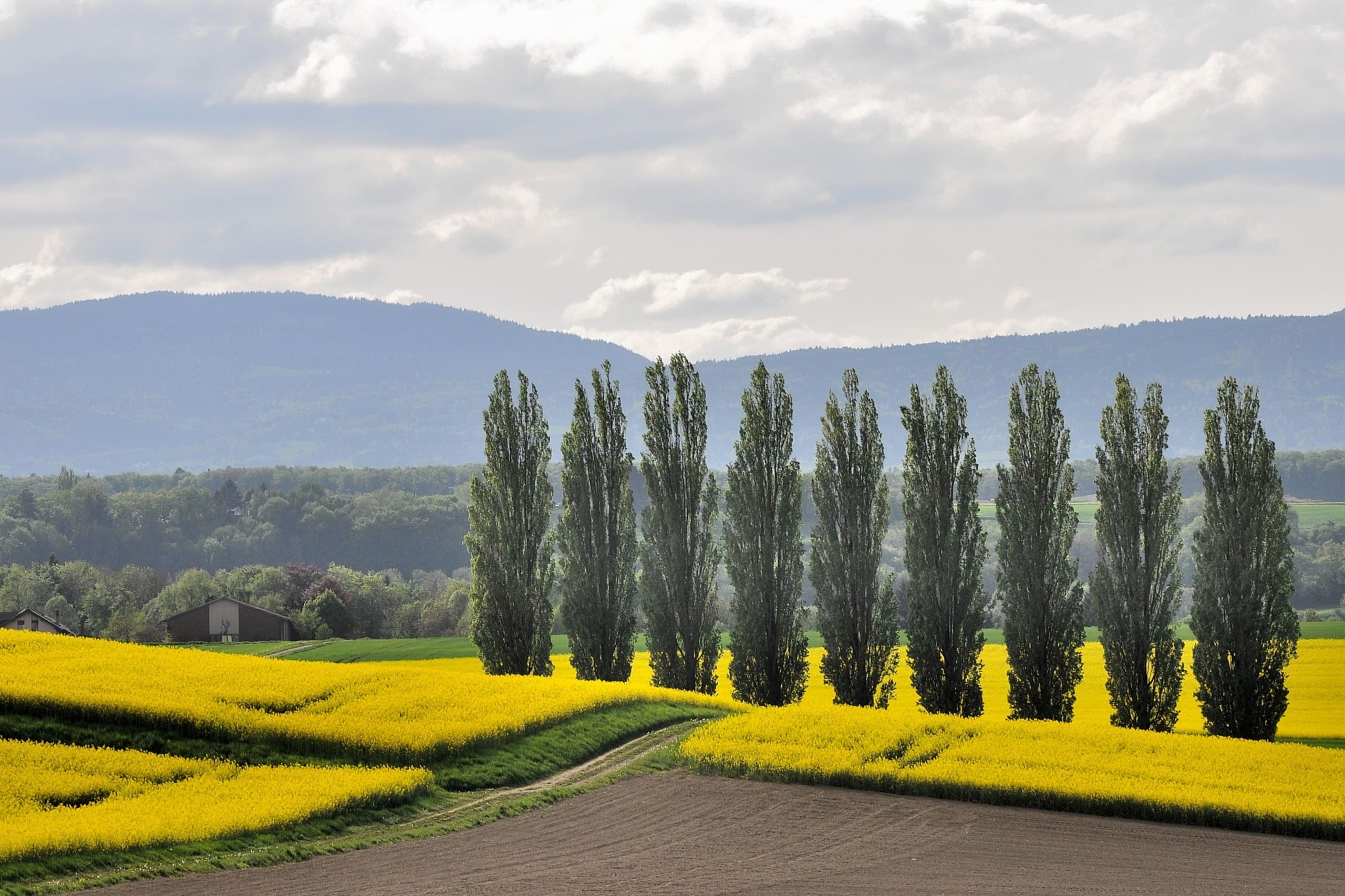
Bettens Bettens is a fine example of the region’s farming villages, with its large farms and vegetable gardens. Here, the route follows long farm tracks lined with a variety of crops. This is a good opportunity to learn how to identify them. Wheat, barley, oats, rapeseed, maize, sunflowers, potatoes, beetroot – each plot has a different texture, scent and colour. The landscape looks as though it has been pieced together from a patchwork of fabrics ranging in colour from brown to green, through various shades of gold.
Daillens In the centre of the village, the church hides its precious treasure. In 2006, exceptional 14th-century paintings were discovered beneath a layer of whitewash. Extensive work was then undertaken to reveal and preserve this testament to the past. The church is not always open, and it is advisable to check with the local council if you wish to visit the building.
Penthalaz Halfway between Daillens and Penthalaz, the farm tracks give way to a forest path. In May, wild garlic carpets the ground and the plant’s distinctive scent fills the air. This is a great opportunity to make a little pesto. But be careful not to confuse wild garlic with colchicum or lily of the valley, which are highly poisonous. At the bottom of the valley, we reach the banks of the Venoge. The river flows past the former Cossonay cable factory (located in the municipality of Penthalaz). This factory, founded in 1898, was, until the 1990s, one of only three factories manufacturing cables for Switzerland. It was also a major source of employment for the region, employing nearly 650 people in the 1950s. A few hundred metres further downstream, the imposing grain silo marks the end of this stage. It concludes at the Penthalaz CFF station (Cossonay-Gare)
Routes mapped out by Thierry Duperrut
, qualified
mountain guide. Email: thierry@montagne-rando.ch
. In collaboration with Echallens Région Tourisme
Link to Stage 1
Link to Stage 3
Link to Stage 4
Link to Stage 5